
Here’s a longer, more detailed, and polished rewrite of your content for AdSense-quality:
Martin Luther King Jr. is widely regarded as one of the most influential figures in the history of the United States. A Baptist minister, humanitarian, and powerful public speaker, he became the leading voice of the Civil Rights Movement during the 1950s and 1960s. His commitment to justice, equality, and nonviolent resistance helped transform American society and inspired movements for human rights around the world.
Born in 1929 in Atlanta, Georgia, King was originally named Michael King Jr. His father later changed both of their names to honor Martin Luther, a historical figure known for challenging injustice and promoting reform. From a young age, King was deeply influenced by his Christian faith, which emphasized love, compassion, and forgiveness. These values would later shape his approach to activism and leadership.
King lived during a deeply divided period in American history, when racial segregation and discrimination were widespread, especially in the southern states. Laws known as “Jim Crow” laws enforced strict separation between Black and white Americans in public spaces such as schools, restaurants, and transportation. African Americans were denied equal rights and often faced unfair treatment under the law. Despite these challenges, King believed that peaceful protest and moral strength could bring about meaningful change.
One of the earliest and most important events in King’s leadership was the Montgomery Bus Boycott. This movement began after Rosa Parks refused to give up her seat to a white passenger on a segregated bus in Montgomery, Alabama. In response, King helped organize a large-scale boycott of the city’s bus system. The protest lasted over a year and eventually led to a Supreme Court decision that declared bus segregation unconstitutional. This success brought national attention to King and established him as a key leader in the civil rights struggle.
At the time, King was serving as a minister at the Dexter Avenue Baptist Church, where he began combining his religious beliefs with social activism. He strongly believed in the principle of loving one’s neighbor and used this idea as the foundation of his nonviolent approach. Inspired in part by leaders like Mahatma Gandhi, King encouraged peaceful demonstrations such as marches, speeches, and boycotts to challenge injustice.
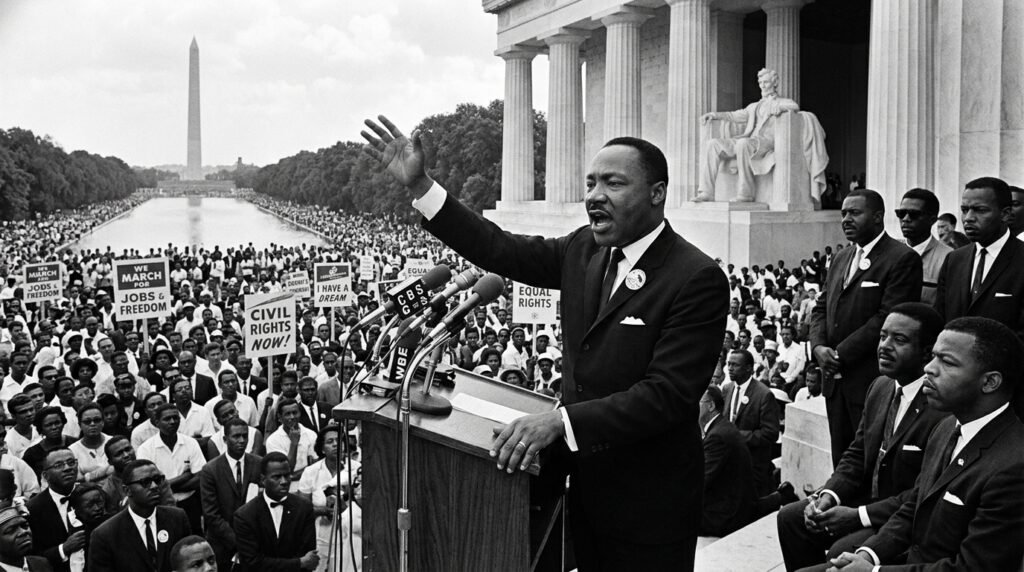
King was also an extraordinary speaker, known for his ability to inspire hope and unity through his words. His most famous speech, I Have a Dream, was delivered during the historic March on Washington. In this speech, King shared his vision of a future where people of all races could live together in harmony and equality. His powerful message—that individuals should be judged by their character rather than the color of their skin—continues to resonate today.
In recognition of his efforts to promote peace and equality, King was awarded the Nobel Peace Prize in 1964, becoming one of the youngest recipients in history at the time. His work helped lead to significant changes in U.S. law, including the Civil Rights Act and the Voting Rights Act, which aimed to end segregation and protect the rights of African Americans.
Tragically, King’s life was cut short when he was assassinated in 1968 in Memphis, Tennessee, at the age of 39. Despite his untimely death, his legacy continues to inspire generations of people around the world. Martin Luther King Jr.’s dedication to justice, equality, and nonviolence remains a powerful example of how one individual can make a lasting impact on society.