
Here’s a longer, more refined, and AdSense-friendly rewrite of your content:
Henry Ford is widely recognized as one of the most influential figures in modern industrial history. While he did not invent the automobile itself, his greatest contribution was transforming how cars were produced and making them accessible to ordinary people. His innovations changed not only the automotive industry but also the global economy and everyday life in the United States and beyond.
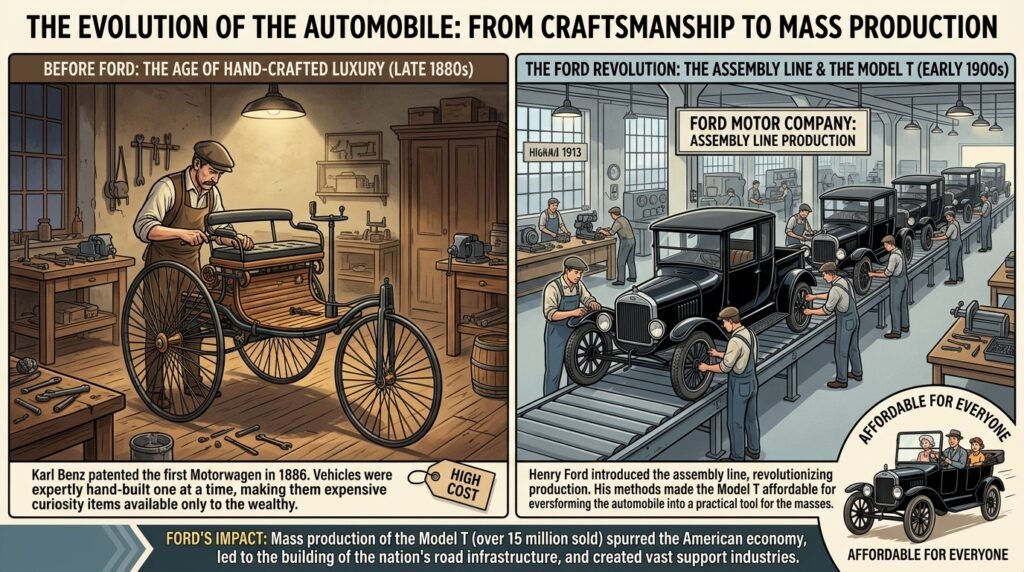
Before Ford’s rise, the first practical automobile had already been developed by Karl Benz in the late 19th century. In 1886, Benz patented his early motor vehicle, often referred to as the Benz Patent-Motorwagen. Although this invention marked a major breakthrough in transportation, these early automobiles were expensive, handcrafted machines that only wealthy individuals could afford. Production was slow and inefficient, as each vehicle was built individually by skilled workers.
Henry Ford revolutionized this system by introducing the concept of mass production through the use of the assembly line. At the Ford Motor Company, founded in 1903, Ford developed a manufacturing process in which each worker performed a specific task as the vehicle moved along a production line. This dramatically reduced the time required to build a car and significantly lowered production costs. As a result, automobiles became more affordable and accessible to the general public.
Ford’s most famous product, the Ford Model T, was introduced in 1908 and quickly became a symbol of innovation and practicality. Known for its durability and simplicity, the Model T was designed to meet the needs of everyday people. It was easy to operate, relatively inexpensive, and suitable for a wide range of uses, from personal travel to transporting goods. Over time, the Model T achieved extraordinary success, becoming one of the best-selling vehicles in history and the first to surpass 15 million units sold.
The impact of Ford’s innovations extended far beyond the automobile itself. By making cars affordable, he helped reshape American society. Roads and highways were expanded and improved to accommodate the growing number of vehicles. Entire industries developed to support automobile use, including fuel production, parts manufacturing, repair services, and maintenance businesses. At one point, it was estimated that a vast majority of cars on American roads were produced by Ford, highlighting the company’s dominance during that era.
Moreover, Ford’s production methods influenced manufacturing practices around the world. The assembly line became a standard approach in many industries, improving efficiency and reducing costs for a wide range of products. His work also contributed to changes in labor practices, including higher wages for workers, which allowed more people to afford the very products they helped create.
Henry Ford’s legacy is deeply connected to the transformation of the 20th century. By turning the automobile from a luxury item into an everyday necessity, he helped shape modern transportation, industry, and economic growth. His vision and innovations continue to influence how goods are produced and how people move through the world today.