
The Enduring Legacy of Star Trek: A Pioneer of Social Commentary and Diversity
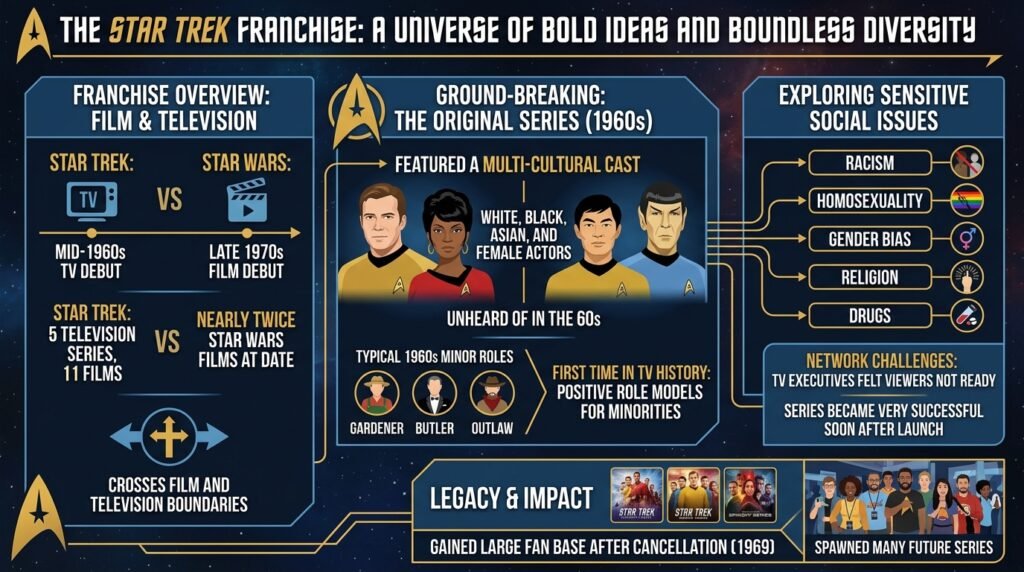
The Star Trek franchise stands as a titan in the entertainment industry, commanding a legacy that spans over half a century. While often compared to its contemporary, Star Wars, Star Trek occupies a unique niche in pop culture. While George Lucas’s space opera found its footing primarily in cinema, Gene Roddenberry’s vision was born on the small screen, preceding the adventures of a galaxy far, far away by more than a decade. Since its debut in 1966, Star Trek has bridged the gap between television and film, creating a cohesive, sprawling universe that remains relevant today.
Breaking the “Glass Ceiling” of 1960s Television
When the original series (now referred to as TOS) premiered in the mid-1960s, the American television landscape was largely monolithic. Programming was predominantly white, and minority characters were often relegated to background roles or harmful stereotypes. Gene Roddenberry, the visionary creator of the series, sought to challenge this status quo.
A Multicultural Vision of the Future
Roddenberry’s “Infinite Diversity in Infinite Combinations” (IDIC) philosophy was revolutionary. The bridge of the USS Enterprise featured a multicultural crew that was unheard of at the time:
- Nichelle Nichols (Uhura): As a Black woman serving as a high-ranking officer, she provided a powerful role model. Dr. Martin Luther King Jr. famously encouraged her to stay on the show, noting that she was playing a character with dignity and professionalism.
- George Takei (Sulu): He broke barriers for Asian-American actors, portraying a skilled pilot rather than a caricature.
- Walter Koenig (Chekov): Introduced during the height of the Cold War, having a Russian officer on the bridge was a bold statement of global unity.
By presenting a future where humanity had moved past racial and nationalistic prejudices, Star Trek provided minority audiences with their first positive, high-status reflections on screen.
A Bold Approach to Social Commentary
Star Trek was never “just a show about space.” It utilized the “Wagon Train to the Stars” format to disguise heavy-hitting social allegories. Because the stories took place on distant planets, Roddenberry could bypass the strict censorship of 1960s TV executives who were wary of controversy.
The series tackled provocative themes that mirrored the turbulent 1960s, including:
- Racial Equality: Episodes like “Let That Be Your Last Battlefield” used alien races to highlight the absurdity of racism.
- War and Politics: The show frequently addressed the ethics of the Vietnam War and the nuclear tensions of the Cold War.
- Gender and Identity: While limited by the era’s standards, the show pushed boundaries regarding gender roles and even featured one of the first interracial kisses on American television.
From Cancellation to a Multi-Billion Dollar Franchise
Despite its current status as a cultural phenomenon, the original series struggled with ratings and was canceled after only three seasons in 1969. However, its life in syndication turned it into a “cult classic,” sparking a massive fan movement that exists to this day.
This grassroots popularity led to an unprecedented expansion of the franchise. To date, the Star Trek universe has produced:
- Television: Over a dozen series, including The Next Generation, Deep Space Nine, Voyager, and modern hits like Discovery and Strange New Worlds.
- Film: 13 feature films (surpassing the original Star Wars saga in sheer volume of individual entries).
- Literature and Games: Thousands of novels, comics, and video games that expand the lore of the United Federation of Planets.
Why Star Trek Still Matters
The success of Star Trek lies in its optimism. While many science fiction stories focus on a dystopian future, Roddenberry’s world posits that humanity will eventually solve its greatest problems—poverty, greed, and prejudice—through science, diplomacy, and exploration.
For modern audiences and AdSense-eligible content, the story of Star Trek isn’t just about phasers and warp drive; it is a blueprint for how media can influence social progress. It proved that viewers were not only ready for difficult conversations but were hungry for a vision of a future where everyone has a seat at the table.