
The Cultural Phenomenon of Star Wars: From a “B-Movie” to a Global Empire
Since its debut in 1977, the Star Wars franchise has done more than just entertain; it has fundamentally redefined the landscape of the modern film industry. Conceived by George Lucas, this “space opera” blended elements of classic mythology, Westerns, and Japanese cinema to create a universe that resonates across generations. Today, it stands as a multi-billion dollar benchmark for successful multimedia storytelling.
A Turbulent Beginning: The Birth of a Legend
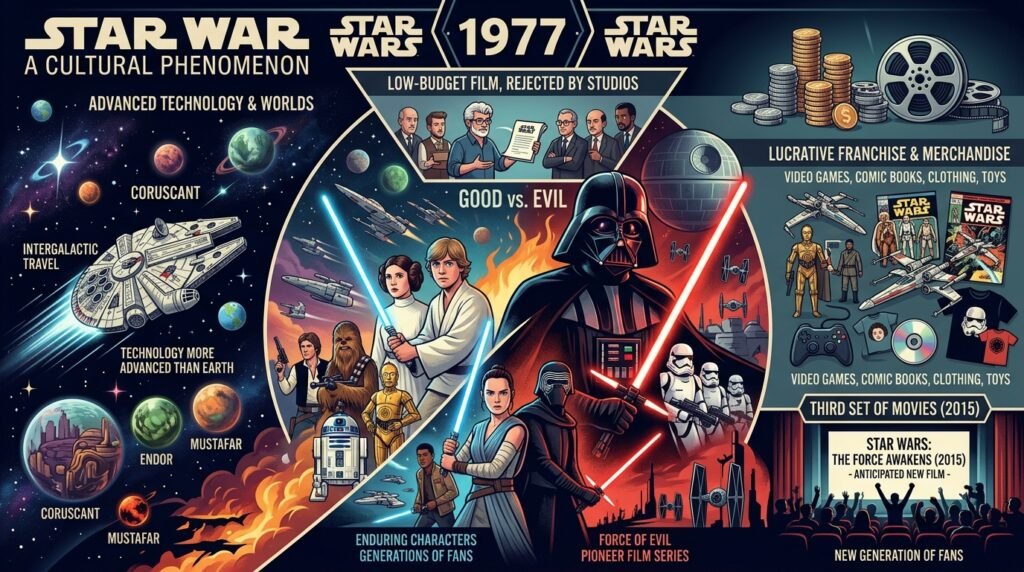
It is difficult to imagine a world without Star Wars, but in the mid-1970s, the film was a massive gamble. George Lucas faced significant skepticism from major Hollywood studios who believed the concept was too abstract for mainstream audiences.
The production was famously plagued by technical difficulties, budget overruns, and a belief among the cast that the film would be a “B-movie” flop. However, upon its release, the film—later subtitled A New Hope—shattered box office records. This success transformed Lucasfilm into a powerhouse and proved that high-concept science fiction had massive commercial potential.
The “Used Future”: Technology and World-Building
One of the most striking aspects of Star Wars is its visual aesthetic. Unlike the pristine, polished sci-fi that preceded it, Lucas introduced a “used future” look. The starships were grimy, the droids were dented, and the worlds felt lived-in.
Beyond Modern Science
While the films are set “a long time ago,” the technology remains far beyond our current capabilities. Key iconic elements include:
- Faster-Than-Light Travel: The use of “Hyperdrive” allows characters to traverse the galaxy in hours, a feat that current physics deems impossible for mankind.
- Sentient Robotics: Droids like R2-D2 and C-3PO showcase a level of artificial intelligence and personality that remains a goal for modern robotics.
- The Lightsaber: Perhaps the most famous weapon in cinematic history, symbolizing the blend of futuristic tech with ancient chivalry.
The Eternal Struggle: Good vs. Evil
At its core, the narrative strength of Star Wars lies in its simplicity. It is a classic hero’s journey that pits “The Force”—an energy field representing life and harmony—against the “Dark Side,” which represents greed, fear, and authoritarianism.
Characters such as Luke Skywalker, Princess Leia, and Han Solo became archetypes of heroism, while Darth Vader remains one of the most recognizable villains in the history of art. This clear-cut moral compass allowed the franchise to transcend language barriers and become a global success, as the themes of redemption and courage are universal.
The Expansion of the Empire: Merchandising and Media
Star Wars pioneered the modern “blockbuster” business model. George Lucas famously retained the merchandising rights to the films, a move that made him a billionaire. The franchise has since expanded into a massive ecosystem of:
- Literature: Hundreds of novels and comic books that explore the “Expanded Universe.”
- Gaming: Critical hits ranging from Knights of the Old Republic to modern titles like Jedi: Survivor.
- Television: The acquisition of Lucasfilm by Disney in 2012 ushered in a new era of streaming, with hits like The Mandalorian and Ahsoka bringing cinematic quality to the small screen.
The Modern Era and Beyond
While the “Sequel Trilogy” (starting with The Force Awakens in 2015) brought the saga of the Skywalker family to a close, the franchise shows no signs of slowing down. As of 2026, Star Wars has successfully transitioned from a series of movies into a permanent fixture of digital culture.
With new films and series constantly in development, the franchise continues to capture the imaginations of new fans. It remains a testament to the power of imagination—proving that a simple story about a farm boy looking at two suns can change the world forever.